Building a Social Media Content Calendar You Will Actually Maintain
A realistic system for planning, batching and repurposing social content — including the ratio that keeps feeds from becoming adverts.
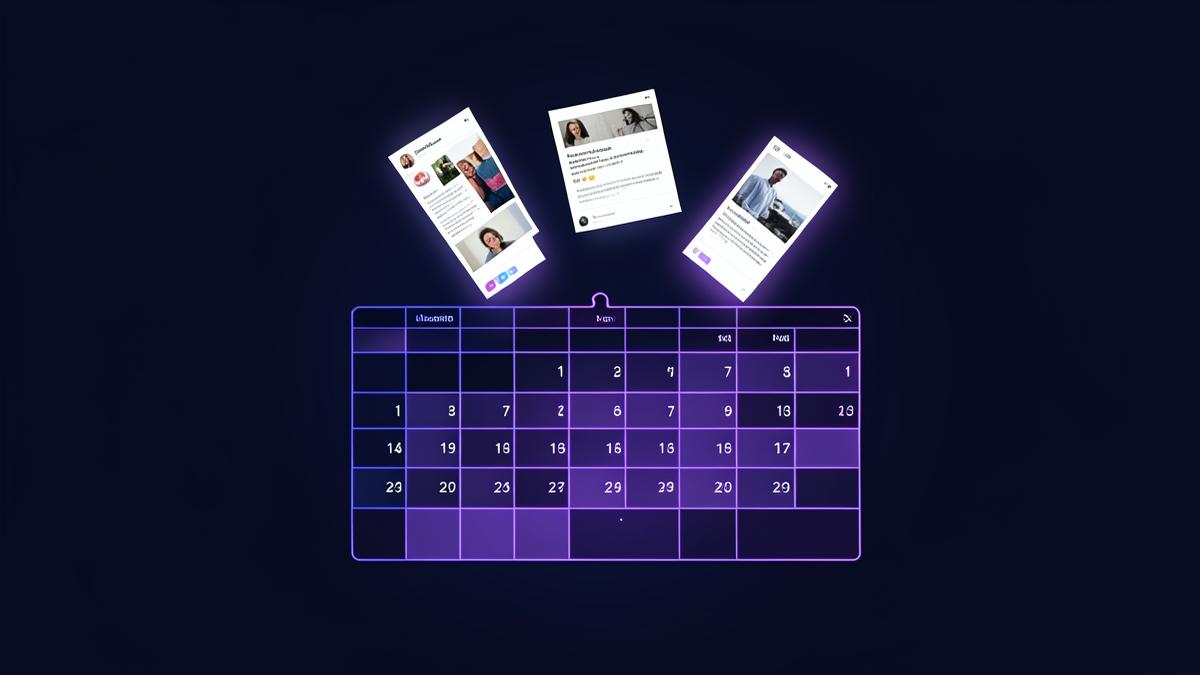
Most content calendars die in week three. Not because the format was wrong, but because they were built for an imaginary version of the team that has four spare hours every Monday. A calendar that survives is one designed around how much you can genuinely produce.
Start with capacity, not ambition
Be brutally honest about how much time exists each week for social content. Two hours? Then plan for two hours. It is far better to post three good things a week for a year than twelve things a week for a month and then nothing.
Pick platforms the same way. One platform done well beats four done badly, and each platform is a genuinely different medium with different formats and expectations. Choose where your audience actually is, not where everyone says you should be.
Define your content pillars
Pick four or five recurring themes and rotate through them. Pillars remove the daily "what do I post" paralysis, which is the real killer of consistency.
A typical set for a product business:
- Educational — how to do something in your field.
- Behind the scenes — how the work happens, what went wrong, what you learned.
- Proof — customer results, case studies, testimonials.
- Opinion — a position on something in your industry.
- Product — features, updates, offers.
Keep product to roughly one post in five. A feed that is all advert gets unfollowed; a feed that never mentions what you sell does not convert.
Batch, do not drip
Producing content daily is exhausting and produces worse work. Instead, set one block each month to plan and one block each week to produce.
Monthly planning session (1–2 hours): map the next four weeks — key dates, launches, seasonal moments, and a theme per week. Fill the grid with pillar assignments rather than finished ideas.
Weekly production block (2–3 hours): write and design everything for the following week in one sitting. Working in one mode is far faster than context-switching daily.
Daily (10 minutes): publish or check the scheduler, and — more importantly — reply to comments. Engagement is the part that cannot be batched, and it is the part that actually grows accounts.
Repurpose relentlessly
One substantial piece of work should become five to ten posts. A single guide contains: the key statistic, a step-by-step carousel, a common mistake, a quote graphic, a short video walkthrough, a poll about the topic, and a link post.
Repurposing is not laziness. Only a small fraction of your audience sees any given post, and repetition across formats is how a message actually lands. Rewrite for each platform's norms rather than cross-posting identically — the same idea, phrased natively.
What the calendar should record
Keep it simple enough to update in seconds: date, platform, pillar, hook or headline, asset status, link, and after publishing, the result. Anything more elaborate becomes admin you will abandon.
The results column matters most. After a couple of months it tells you which pillar and which format consistently outperform, and your calendar starts writing itself around what works.
Building a buffer
The single best predictor of whether a calendar survives is whether there is a queue. Aim to stay two weeks ahead. That buffer absorbs illness, holidays, launches and the weeks where everything goes wrong — which are precisely the weeks a just-in-time calendar collapses.
Keep an "evergreen" folder of five to ten posts that are not time-sensitive. When a week falls apart, you publish from the folder instead of publishing nothing.
Review monthly, adjust quarterly
Once a month, spend twenty minutes on the numbers: what performed, what did not, what took more effort than it was worth. Once a quarter, revisit the pillars and the platform choice.
Consistency beats brilliance here almost every time. An ordinary calendar you maintain for a year will outperform an exceptional one you maintain for six weeks — so design for the version of yourself who is busy and tired, not the one who is inspired.